
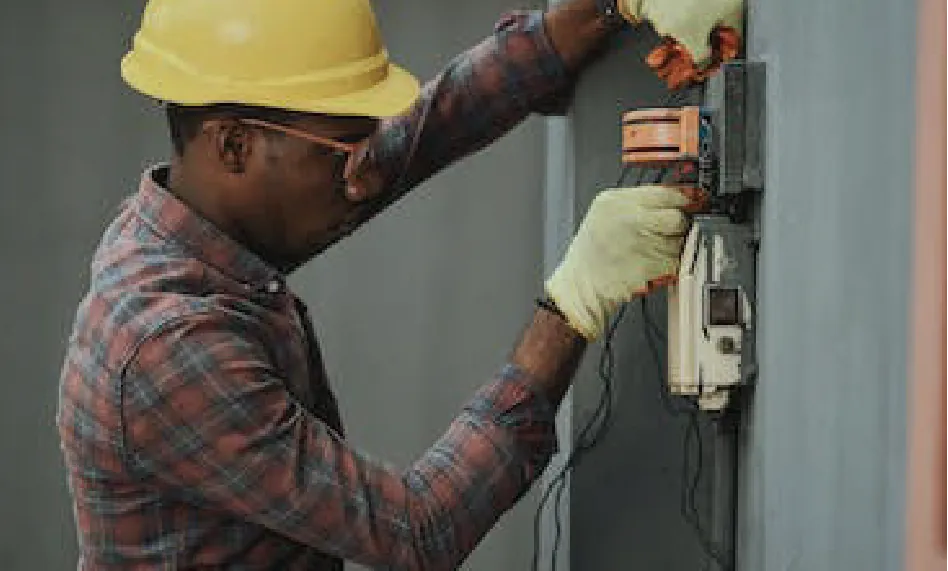
Prepaid Electricity Meters in Uganda
STS keypad, split and smart 4G prepaid meters for homes, rentals, estates and utilities, supplied and supported from Ntinda, Kampala.
The basics
What is an STS prepaid meter?
A prepaid electricity meter works like pay-as-you-go airtime. The customer pays first, then uses the power they have bought. Instead of an estimated monthly bill, the meter holds a credit balance and counts it down as electricity is used. At zero credit the built-in relay opens and supply stops until the customer tops up.
STS stands for Standard Transfer Specification, the international standard behind most prepaid meters. It defines how credit travels to the meter as a 20-digit token. Each token is encrypted for one meter, can be used only once and cannot be copied to another meter, so credit stays secure from the point of sale to the keypad.
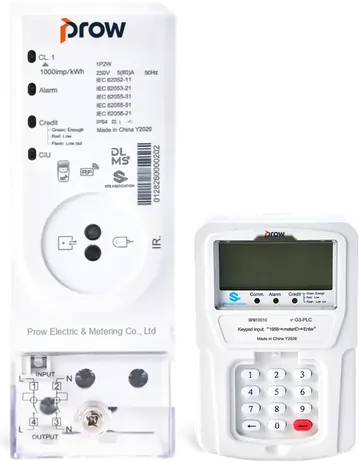
Prow prepaid meters support the STS token standard (IEC 62055-41) and measure active energy to Class 1.0, so what the customer pays for is what the meter records.
Token vending
How token vending works
Behind every token is a vending system. Prow supplies meters together with the vending and management system that issues tokens, manages tariffs and records sales.
- 1
Customer pays
Payment is made at a vending point or through a payment channel connected to your vending system. Mobile money is one of the channels a vending system can be set up to accept; channels are configured for each project.
- 2
Token is generated
The vending system creates a 20-digit STS token for that customer’s meter and the amount paid, using your tariff.
- 3
Token is entered
The customer types the token on the meter keypad, or on an indoor customer interface unit. The meter checks it, adds the credit and shows the new balance.
- 4
Meter manages supply
The meter warns when credit runs low and disconnects at zero. Emergency credit can bridge short gaps.
Featured: PRW-SD-110
Featured: PRW-SD-110 split prepaid meter
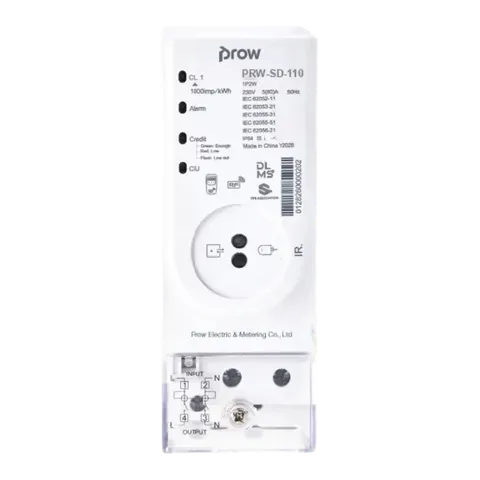
The PRW-SD-110 is a split-type STS prepaid meter designed for apartments, estates and hostels. The DIN-rail meter is installed in a secure, locked meter room or meter box. The customer never handles it. Instead, they enter tokens and check their balance on an indoor customer interface unit (CIU) in their home.
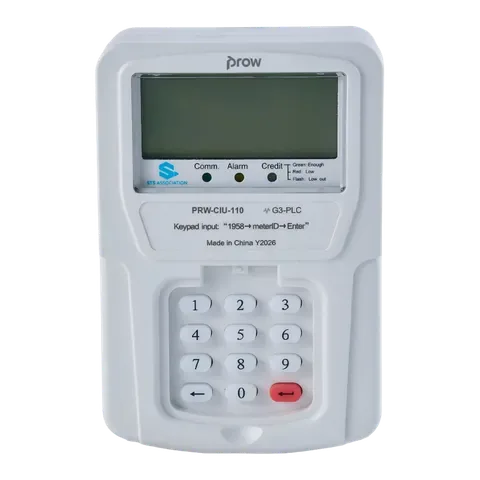
Keeping the measuring unit and relay out of reach makes tampering and bypass much harder. The relay opens if the terminal cover is removed, even during a blackout, and the double-circuit relay switches supply on and off. The CIU talks to the meter over power line with the PRW-CIU-110, or over long-range RF with the PRW-CIU-120. Both have a backup battery, so customers can still enter tokens during an outage.
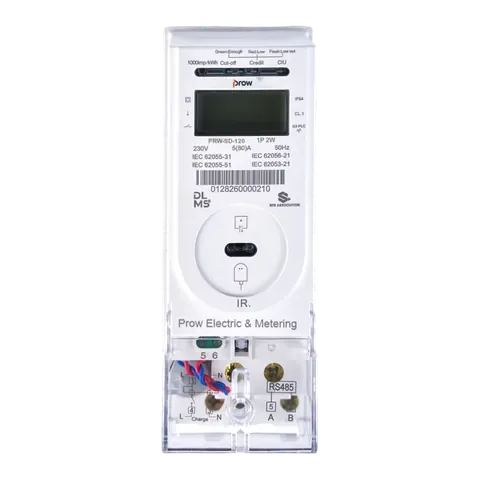
Need the meter display mirrored indoors? The PRW-SD-120 shows the same readings on the CIU in real time.
- Meter installed in a secure meter room or meter box
- Customer enters 20-digit STS tokens on the indoor CIU
- Wired (M-Bus, PLC/G3-PLC) or wireless (LoRa RF) link to the CIU
- Relay opens if the terminal cover is removed, even during a blackout
Choose your meter
Keypad, split or smart: which prepaid meter fits?
All three types use the same STS tokens. The difference is where the keypad sits and how much remote visibility you want.
Split meters with an indoor unit
The DIN-rail meter stays in a locked meter room. Customers enter tokens on an indoor customer interface unit linked by power line (PRW-CIU-110) or long-range RF (PRW-CIU-120). The relay opens if the terminal cover is removed, even during a blackout.
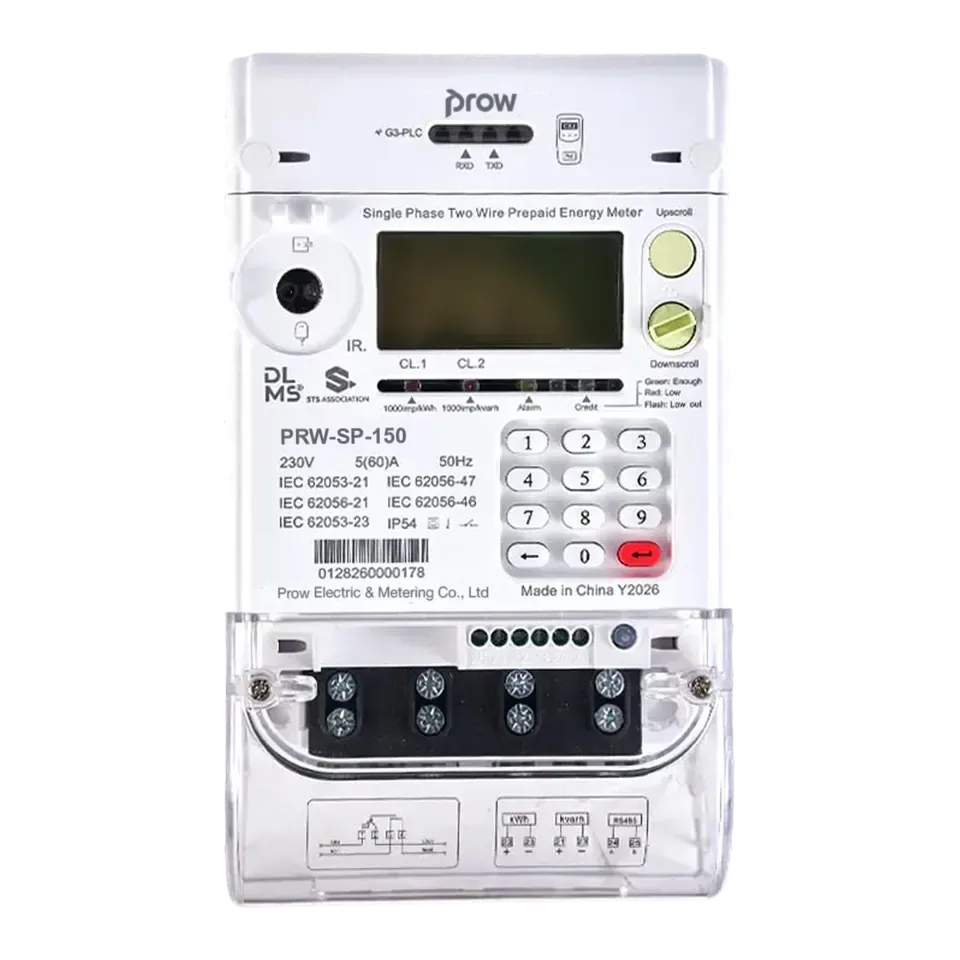
Keypad (monobloc) meters
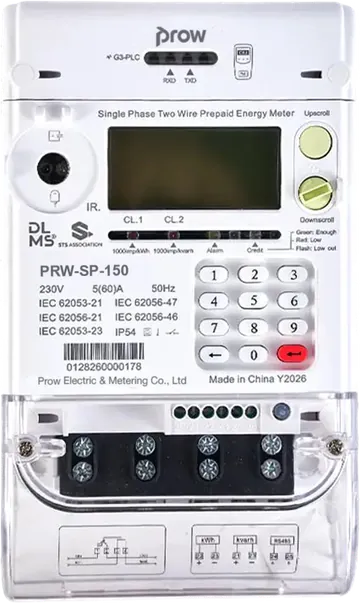
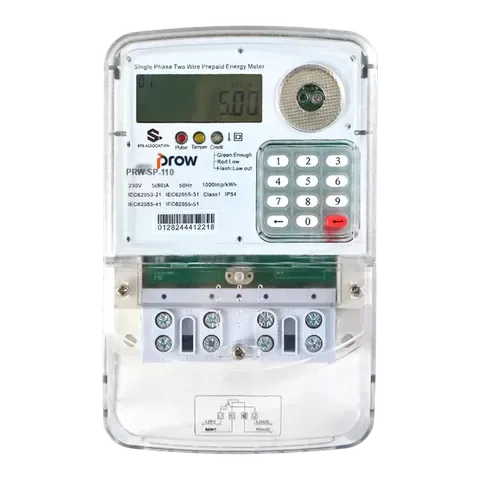
Meter, keypad and display in one housing. The PRW-SP-110 suits homes, shops and rental units. The PRW-SP-150 is our modular flagship, ready for plug-in PLC, RF, GPRS, 3G or 4G modules when you want remote reading.
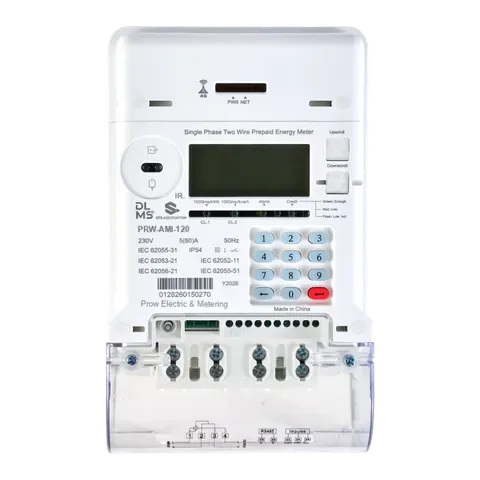
Smart 4G prepaid meters
Smart meters such as the PRW-AMI-120 combine a local keypad with remote management over 4G, PLC or RF, for operators who want to read and control meters from the office.
Supply type
Single-phase and three-phase prepaid meters
Most homes, shops and rooms in rental blocks run on a single-phase supply. Our single-phase prepaid meters cover reference voltages from 110 to 240 V at 50 or 60 Hz, with a basic current of 5 A or 10 A and a maximum of 40, 60, 80 or 100 A.
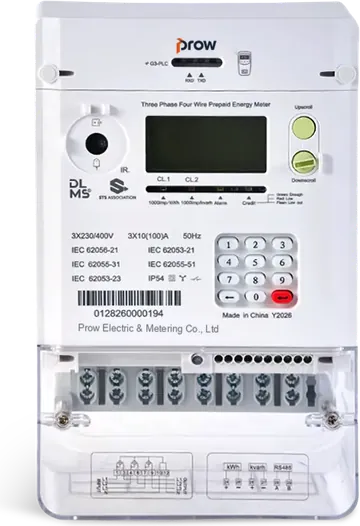
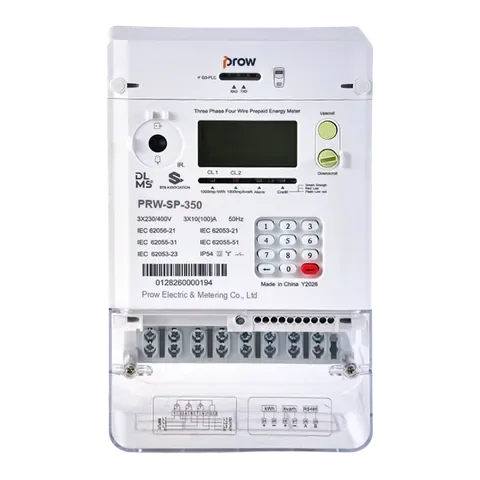
Workshops, larger homes and commercial premises on a three-phase, four-wire supply can use the PRW-SP-350, a three-phase keypad prepaid meter for 3×230/400 V with a clear LCD, an infrared port and DLMS/COSEM. If you are unsure which supply you have, an electrician or our team can confirm it before you order.
Who it is for
Who uses prepaid meters?
Prepaid metering suits anyone who sells or shares electricity and wants to be paid before it is used.
- Landlords and property managers sub-metering tenants: see prepaid sub-meters for landlords
- Apartment blocks, hostels and dormitories using split meters
- Shops, workshops and small businesses
- Estates, rural mini-grids and utilities that need remote reading
Why Prow
Local support from Ntinda, Kampala
Prow Electric & Metering is based at Ntinda Shopping Centre, Room D-16, Kampala. Our team helps you choose between keypad, split and smart meters, supports installation and commissioning, sets up vending and provides after-sales service.
Tell us your meter types, quantities and location through the quote form, or call +256 703 353 316 and talk it through. We reply with a quotation and lead time.
- One team for meters, vending system and support
- Keypad, split and smart models in one range
- Datasheets and advice on request
Prepaid meter models
A selection from the prepaid range. Open any model for full specifications.
FAQ
Frequently asked questions
How does a prepaid electricity meter work?
The customer buys credit first and receives a 20-digit STS token. Entering the token on the meter keypad, or on an indoor display, adds the credit. The meter counts down as power is used and warns the customer before credit runs out.
Can a token be used on another meter?
No. Every STS token is encrypted for one specific meter, can only be used once and cannot be copied to another meter.
What is the difference between a keypad meter and a split meter?
A keypad meter has the keypad and display on the meter itself. A split meter keeps the measuring unit in a secure meter room and gives the customer an indoor unit to enter tokens, which suits apartments, estates and hostels.
What happens when credit runs out?
The meter warns the customer as credit gets low. At zero it disconnects supply automatically. Emergency credit can be configured to bridge short gaps, and the PRW-SP-150 also supports a weekend and holiday friendly-credit mode.
Can customers buy tokens with mobile money?
A vending system can be set up with several payment channels, including mobile money. Channels are configured for each project, so tell us what you need and we will confirm what is possible.
Do you supply single-phase and three-phase prepaid meters?
Yes. Single-phase models include the PRW-SP-110, PRW-SP-120, PRW-SP-150 and the split PRW-SD-110. The PRW-SP-350 is our three-phase keypad prepaid meter.
Can a prepaid meter be read remotely later?
Yes. The PRW-SP-150 accepts plug-in PLC, RF, GPRS, 3G or 4G modules, so you can start with local top-up and add remote reading and management when you are ready.
Where can I buy prepaid meters and get support?
Visit us at Ntinda Shopping Centre, Room D-16, Kampala, call +256 703 353 316 or email metering@prow.ug. Our team advises on selection and supports installation, commissioning and after-sales service.
Visit or call Prow
Ntinda Shopping Centre, Room D-16, Bukoto–Ntinda Road, Ntinda, Kampala, Uganda
Related

Not sure which meter you need? Answer 4 quick questions and we’ll point you to the right one.